
Top 10 Order Management Systems (OMS) for Indian Omnichannel Brands (2026)
"OMS" in India means two different products wearing one name. One routes consumer parcels — marketplace orders in, courier labels out. The other runs the purchase-order world — quick commerce, modern trade, general trade, and institutional B2B, where orders arrive as POs against a GSTIN with fill-rate penalties attached. Most bad OMS purchases come from buying one when you needed the other. This list covers both, and every entry — including our own product, at #1 — carries an explicit "who it's not for" note.
Before you read: yes, FilFlo is our product
This list is published by FilFlo, and FilFlo is ranked first. Rather than pretend otherwise, here is the deal: we describe FilFlo the same way we describe everyone else — what it actually does, who it fits, and who it does not. FilFlo is the order-to-cash operations layer for FMCG brands selling through quick commerce — which, in OMS terms, makes it a B2B-first order management system: the strongest option on this list for brands whose orders arrive as purchase orders from quick commerce, modern trade, general trade distributors, and institutional buyers. It is not a courier-aggregation OMS for brands shipping thousands of single consumer parcels a day — for that job, other entries here are the better buy, and we say so. Everything written about other vendors comes from their public positioning; no fabricated ratings, review counts, or user numbers anywhere on this page.
⚡ Key Takeaways
- "OMS" covers two order lifecycles: B2C consumer parcels (marketplace sync, courier booking, returns) and B2B purchase orders (PO ingestion, per-GSTIN invoicing, GRN reconciliation). Decide which one is eating your margin before comparing features.
- Marketplace-heavy brands fit Unicommerce, EasyEcom, or Increff; brands growing through Blinkit, Zepto, DMart, distributors, and institutional accounts need the PO-to-GRN loop FilFlo runs.
- Omnichannel means both lifecycles at once — the winning setup is usually a B2C layer and a B2B layer sharing one inventory truth, not one tool stretched over both.
- Zoho Inventory is the budget entry point; IBM Sterling and Manhattan Active are the enterprise ceiling; nearly everything else is quote-based mid-market SaaS.
- India-specific compliance — IRN e-invoicing, e-way bills, per-GSTIN series — is table stakes for B2B channels; global platforms bolt it on, India-first vendors build it in.
How We Picked: What "Order Management System India" Actually Means
An order management system owns the order lifecycle: capture, validation, allocation against stock, fulfilment orchestration, invoicing, and closure. In India the phrase hides a fork. An e-commerce OMS is built around the consumer parcel — syncing Amazon, Flipkart, Meesho, and Shopify orders, splitting them across warehouses, booking couriers, processing returns. A B2B order management system is built around the purchase order — the document Blinkit, Zepto, Swiggy Instamart, modern trade chains, general trade distributors, and institutional buyers send, pinned to a GSTIN, with channel SKU codes, appointment dates, and fill-rate penalties. The lifecycle there is PO in → approval → pick → GST e-invoice with IRN → e-way bill → dispatch → delivery → GRN reconciliation.
A brand doing both — which is what "omnichannel" actually means operationally — needs both lifecycles handled well, drawing on one stock pool. This list spans B2C-first platforms, B2B-first platforms, one budget anchor (Zoho Inventory), and two enterprise anchors (IBM Sterling, Manhattan Active) so you can see where the mid-market sits. It is the companion piece to our Top 10 Warehouse Management Solutions guide — the OMS decides what happens to an order; the WMS decides what happens on the floor. On pricing: nearly everything here is quote-based, and we do not invent numbers — including for our own product.
Comparison Table: Best OMS for Indian Brands at a Glance
| Solution | Category | Best for | Watch out for |
|---|---|---|---|
| 1. FilFlo | Order-to-cash operations layer (B2B-first OMS) | Brands with PO-driven growth: quick commerce, modern trade, general trade, institutional | Not a courier-aggregation OMS for high-volume B2C parcels |
| 2. Unicommerce | E-commerce OMS + WMS | High-volume B2C marketplace and D2C website sellers | B2B PO/GRN workflows are not its centre of gravity |
| 3. Vinculum Vin eRetail | Omnichannel retail suite | Brands, distributors, and 3PLs wanting one broad suite | Breadth over depth; implementation takes real effort |
| 4. Increff OMS | Piece-level OMS + WMS | Fashion, footwear, lifestyle brands with serialized inventory | Fashion-first DNA; batch/expiry FMCG needs less native |
| 5. EasyEcom | OMS with reconciliation edge | Marketplace-heavy D2C brands who care about payment reconciliation | B2B purchase-order lifecycle is not the core loop |
| 6. Zoho Inventory | Inventory + order software | Early-stage brands on a budget, Zoho ecosystem users | Outgrown once B2B POs and multi-warehouse ops become daily reality |
| 7. Prozo ProOMS | OMS + WMS + fulfilment stack | Brands wanting software and managed fulfilment from one vendor | Best value assumes using Prozo's fulfilment network too |
| 8. Omniful | OMS + WMS + TMS | Dark-store and hyperlocal fulfilment operators | Young platform; MENA-first, India presence newer |
| 9. IBM Sterling OMS | Enterprise order orchestration | Large retailers orchestrating orders across hundreds of nodes | Enterprise cost and timeline; India compliance via partners |
| 10. Manhattan Active Omni | Enterprise omnichannel OMS | Multinational retail with store fulfilment at scale | Sized and priced for enterprises, not mid-market brands |
1. FilFlo — The B2B-First OMS for Quick Commerce, Modern Trade, General Trade & Institutional Sales
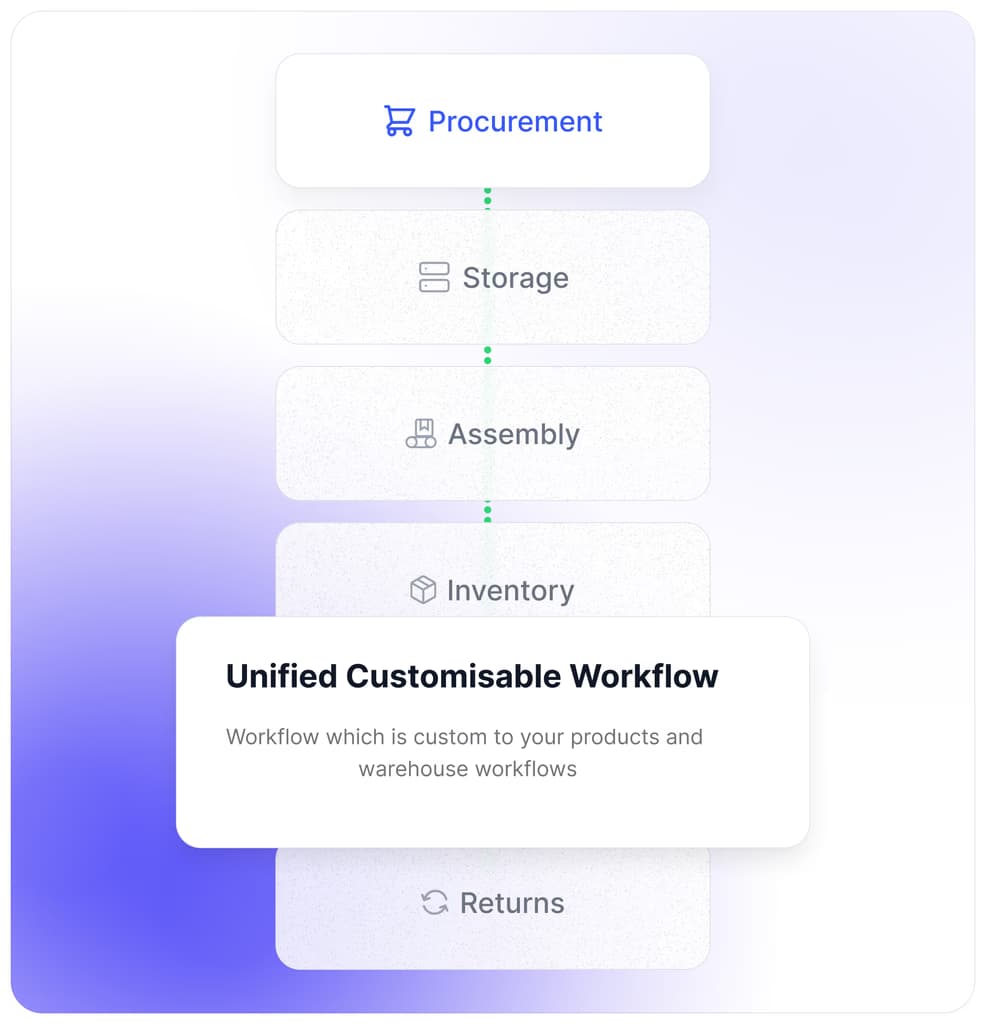
FilFlo is the order-to-cash operations layer for FMCG brands selling through quick commerce — built for the PO side of Indian commerce, where growth is actually coming from for most consumer brands. It runs the full B2B order lifecycle: channel PO ingestion (dedicated CSV parsers for Blinkit, Zepto, and Swiggy Instamart files, plus fully automated inbound POs), approval with reasoned quantity cuts, FIFO picklists allocated by rack and inward date, GST e-invoicing with IRN on the correct per-GSTIN series — including bill-from/ship-from invoicing so a PO pinned to one state's GSTIN can ship from any warehouse — e-way bills auto-generated on dispatch, delivery confirmation, and GRN reconciliation with typed mismatch reasons, which is what decides your fill rate and your payment.
The same order engine covers every PO-driven channel: quick commerce, modern trade chains, general trade distributors, and institutional buyers, each with their own price lists, credit terms, and invoice series. B2C is handled by ingestion rather than duplication — marketplace and D2C orders flow in via file import or from platforms like EasyEcom, so every channel draws down one stock pool tracked at batch, rack, and QR-coded-case level with MFG/expiry dates. On top of the order layer sits FilFlo's AI replenishment engine: SKU × location demand forecasting that drafts purchase orders and flags stockout risk before it lands. Brands like Anveshan, Sleepy Owl Coffee, and Jimmy's Cocktails run their omnichannel order operations on it — the replenishment engine and PO-to-GRN loop are designed to reduce stockouts and free working capital tied up in excess inventory. Pricing is quote-based; write to [email protected] or book a demo below.
Who it's not for: FilFlo is not a courier-aggregation OMS. A brand whose entire business is thousands of single B2C parcels a day — label printing, courier allocation, NDR follow-up — should buy Unicommerce or EasyEcom below, and several FilFlo customers run exactly that pairing. FilFlo's design assumption is that the hard, margin-deciding problem is the purchase-order lifecycle, and that is where it goes deepest.
2. Unicommerce — The Default E-commerce OMS for High-Volume B2C Sellers
Unicommerce is India's most widely deployed e-commerce enablement platform, pairing an order management system with warehouse management. Its core strength is B2C at volume: syncing consumer orders from Amazon, Flipkart, Meesho, Myntra, and D2C storefronts through a claimed 270+ integrations, routing them to the right warehouse, running pick-pack-ship, booking couriers, and processing returns. If your operation is thousands of consumer parcels a day, it is the safe, proven default — a listed Indian company with the marketplace connector coverage and support organisation to match.
Honest limitation: the platform's centre of gravity is the consumer parcel. The B2B purchase-order world — Blinkit PO files with channel SKU codes, per-GSTIN invoice series, GRN mismatch reasons, distributor credit terms — is not what it was architected around, so PO-heavy brands typically pair it with a B2B layer. Our Unicommerce vs FilFlo comparison covers exactly this split.
3. Vinculum Vin eRetail — The Broad Omnichannel Suite
Vinculum's Vin eRetail is one of the longest-running Indian retail SaaS suites, with OMS and WMS as anchor modules plus marketplace listing and vendor panels around them. It targets an unusually wide buyer set — brands, retailers, distributors, marketplaces, and 3PLs — backed by 175+ ready integrations across sales channels, last-mile operators, ERPs, and financial software. The OMS handles B2B and B2C fulfilment from the same stock pool, with real FMCG and health-and-beauty deployments alongside fashion, which makes it a sensible shortlist entry for a mid-size brand or distributor that wants one vendor covering order management, warehousing, and marketplace sync together.
Honest limitation: breadth is the trade-off. A suite serving five buyer personas is rarely the deepest tool for any one of them, and getting full value out of Vin eRetail is an implementation project — master data, integration configuration, process mapping — not a self-serve signup. Insist on referenceable deployments in your specific category.
4. Increff OMS — Piece-Level Accuracy for Fashion and Lifestyle
Increff, from Bengaluru, pairs its OMS with a WMS built around one idea executed unusually well: serialize every single piece. Every unit gets a unique code at inward, so order allocation, picking, and returns are 100% scan-based and the same physical inventory can be exposed to every channel simultaneously instead of maintaining channel-wise reserves. It reports 700+ retail brands globally, with fashion and footwear names like PUMA India and Birkenstock India among its public case studies. For apparel, footwear, and lifestyle brands — high SKU counts, size-colour matrices, heavy returns — this piece-level model is arguably the best-engineered option on this list.
Honest limitation: the DNA is fashion. Serializing every piece makes less sense for a ghee jar or a beverage case, where the unit of truth is the batch and its expiry date. FMCG brands should test batch/expiry, FEFO, and case-level workflows hard — they exist, but they are not the product's heartland. Our Increff vs FilFlo comparison goes deeper on this boundary.
5. EasyEcom — OMS with a Reconciliation Edge
EasyEcom positions itself as an omnichannel OMS-plus-WMS for Indian sellers, with inventory sync across a large set of marketplace integrations. Two things distinguish it. First, reconciliation tooling: automated marketplace payment reconciliation that flags overcharges and unpaid dues, plus a video system tying packing footage to order IDs as evidence in returns disputes — unglamorous features that directly protect margin. Second, its aggregation role: many brands use EasyEcom as the hub pulling Shopify, Amazon, JioMart, and Myntra orders into one queue. (Brands can run EasyEcom as the B2C parcel layer alongside FilFlo's PO-driven B2B layer, with explicit inventory ownership between the two.)
Honest limitation: like Unicommerce, its strength is the marketplace-facing layer. The B2B purchase-order lifecycle — GRN reconciliation with mismatch reasons, fill-rate attribution, per-GSTIN series, distributor and institutional order terms — is not the product's core loop. See our EasyEcom vs FilFlo comparison for the detailed split.
Orders Coming From Blinkit, DMart, Distributors — and Amazon Too?
See how FilFlo runs the full B2B order lifecycle — PO in, FIFO pick, IRN e-invoice, e-way bill, GRN reconciliation — while your B2C channels draw on the same stock pool.
6. Zoho Inventory — The Budget Entry Point
Zoho Inventory is inventory-and-order software rather than a full OMS, and it earns its place as the honest starting point. It covers sales orders and purchase orders, stock across multiple warehouses, batch and serial tracking, composite items, GST-compliant invoicing, low-stock alerts, and integrations with Shopify, Amazon, and the rest of the Zoho suite. Uniquely on this list, it publishes its pricing — tiered plans including a free tier with order caps — making it the rare option a two-person team can evaluate without a sales call. For an early-stage brand doing modest volumes, especially one already on Zoho Books, it beats spreadsheets comprehensively.
Honest limitation: it is not built for channel PO operations — Blinkit PO parsing, appointment-aware dispatch, GRN mismatch reasons, fill-rate attribution — and order-volume caps on lower plans bite as you grow. Brands typically outgrow it when B2B channel POs become daily reality. Our Zoho Inventory vs FilFlo comparison covers the graduation point in detail.
7. Prozo ProOMS — OMS Plus a Fulfilment Network
Prozo is a supply chain company that pairs its software stack — OMS, WMS, and multi-carrier shipping — with a national network of fulfilment centres it operates itself. ProOMS handles multi-channel order orchestration across marketplaces, D2C, quick commerce, and B2B, with intelligent routing across warehouses. The pitch is one accountable vendor for both the software and the physical fulfilment, which appeals to brands that want to outsource warehousing while keeping one view of orders and inventory.
Honest limitation: the software and the fulfilment network are designed to be better together, so the economics are most attractive if you also use Prozo's 3PL services. A brand that only wants standalone OMS software, on its own warehouses or its own 3PLs, should compare the software layer against the specialists on this list feature by feature.
8. Omniful — OMS + WMS + TMS for Dark-Store and Hyperlocal Operations
Omniful bundles order management, warehouse management, and transportation management into one platform, with an explicit focus on quick commerce and hyperlocal delivery — dark stores, micro-warehouses, batch and zone picking tuned for speed, and returns handling for both customer and courier returns. The relevant distinction: Omniful is built for operators running fast fulfilment — retailers and providers operating their own dark stores. That is a different job from a brand selling into Blinkit or Zepto, which is a purchase-order and GRN problem, not a rider-dispatch problem.
Honest limitation: it is a young platform that grew up MENA-first; its India presence, local marketplace integrations, and GST-compliance tooling are newer than the domestic incumbents'. If you are a brand rather than a fulfilment operator, most of the TMS layer is surplus.
9. IBM Sterling Order Management — Enterprise Order Orchestration
IBM Sterling OMS is one of the longest-standing enterprise order management platforms globally, built for retailers and brands orchestrating orders across hundreds of fulfilment nodes — stores, DCs, drop-ship vendors — with sophisticated available-to-promise logic, order splitting, and backorder management. Large Indian retail groups and multinationals with complex omnichannel networks are its natural home, usually deployed and customized by a system integrator as part of a broader enterprise stack.
Honest limitation: everything about it is enterprise-scale — licensing, integrator-led implementations measured in quarters, and a dedicated team to run it. India-specific compliance (IRN, e-way bills) arrives via partners and customization rather than out of the box. For a mid-market consumer brand, it is the wrong size.
10. Manhattan Active Omni — The Enterprise Omnichannel Ceiling
Manhattan Active Omni is the other enterprise reference point: a cloud-native order management platform for multinational retail, strongest where stores are fulfilment nodes — ship-from-store, click-and-collect, real-time inventory availability across a global network. Alongside IBM Sterling, it defines what "full enterprise OMS" means, and we include it so the rest of this list has context: this is the ceiling of the category, not the mid-market default.
Honest limitation: it is sized, priced, and implemented for global enterprise retail. An Indian consumer brand growing through quick commerce POs and distributor networks would be buying store-fulfilment machinery it will never switch on.
How to Choose an OMS: Five Questions Before Any Demo
Feature grids converge; order lifecycles don't. Answer these five questions and most of this list eliminates itself:
- Where do your orders come from? Consumer parcels point to Unicommerce/EasyEcom/Increff. POs from quick commerce, modern trade, general trade, or institutional buyers point to FilFlo. Both means both, sharing one stock pool.
- What does a bad week cost you? If it's missed couriers and NDRs, buy parcel-side depth. If it's fill-rate penalties, GRN deductions, and expired e-way bills, buy PO-side depth.
- Can the demo run your ugliest order? Bring a real Blinkit PO with a quantity cut, or a 500-parcel marketplace day. Watch the tool do it end to end, not slide by slide.
- What does GST compliance look like in the flow? Per-GSTIN invoice series, IRN inside the order lifecycle, e-way bills on dispatch, bill-from/ship-from support. India-first vendors build this in; global platforms bolt it on.
- Who owns inventory truth? An OMS allocating against stale stock numbers creates the exact oversells and short-ships you bought it to prevent. Ask how inventory syncs, how often, and what happens when it disagrees with the warehouse.
Frequently Asked Questions
What is the best order management system in India for consumer brands?
It depends on which orders you mean. If your volume is B2C consumer parcels from Amazon, Flipkart, Meesho, and your D2C site, a marketplace OMS like Unicommerce, EasyEcom, or Increff is the natural fit. If your growth is B2B purchase orders — from Blinkit, Zepto, and Swiggy Instamart, from modern trade chains, from general trade distributors, or from institutional buyers — you need an order-to-cash operations layer like FilFlo that runs PO ingestion, approval, FIFO picking, GST e-invoicing, e-way bills, and GRN reconciliation. Omnichannel brands doing both typically run one of each, integrated, rather than forcing one tool to do a job it wasn't architected for.
Is FilFlo an order management system (OMS)?
Yes — FilFlo is the order-to-cash operations layer for FMCG brands selling through quick commerce, and it functions as the OMS for B2B and omnichannel order operations. FilFlo runs the full order lifecycle for purchase-order-driven channels: quick commerce (Blinkit, Zepto, Swiggy Instamart), modern trade, general trade distributors, and institutional sales — from PO ingestion through approval, picklist, IRN e-invoice, e-way bill, dispatch, delivery, and GRN reconciliation. It also ingests B2C orders from marketplaces and D2C storefronts (via file import or platforms like EasyEcom) so all channels draw on one stock pool. What FilFlo is not is a consumer-parcel courier-aggregation OMS — for thousands of single B2C shipments a day, it pairs with the marketplace OMS layer rather than replacing it.
What is the difference between an OMS for e-commerce and an OMS for quick commerce or modern trade?
An e-commerce OMS is built around the consumer parcel: sync marketplace orders, route them to a warehouse, book a courier, manage returns. Quick commerce, modern trade, and general trade run on purchase orders instead: the channel sends a PO against a specific GSTIN with channel SKU codes, appointment dates, and fill-rate penalties. Managing that requires PO parsing, quantity-cut approval, per-GSTIN invoice series with IRN, e-way bills, appointment-aware dispatch, and GRN reconciliation with mismatch reasons. Most OMS buying mistakes in India come from buying a parcel-routing tool for a PO problem, or vice versa.
Do omnichannel brands need one OMS or several?
Usually a clean pair: a B2C layer for marketplace and D2C parcel flow, and a B2B layer for PO-driven channels — sharing one inventory truth. A brand selling on Amazon and Shopify while supplying Blinkit, DMart, and 200 distributors has two structurally different order lifecycles. Tools that claim to do everything usually do one side natively and the other as an afterthought. The practical test: ask the vendor to demo a Blinkit PO with a quantity cut and a GRN mismatch, then a 500-parcel marketplace day — few platforms are convincing at both.
How much does an order management system cost in India?
Almost every serious OMS vendor in India prices by quote, moving with order volume, channel count, users, and integrations. Zoho Inventory is the budget exception with published tiered plans. At the top end, IBM Sterling and Manhattan Active are enterprise implementations where system-integrator cost typically exceeds licensing. Whatever you choose, the real cost driver is onboarding: SKU master cleanup, channel SKU mapping, and integration setup are where timelines actually go.
The Fastest Way to Shortlist: See One Order Run End-to-End
Bring a real Blinkit, DMart, or distributor PO to a 30-minute demo and watch FilFlo take it from import to IRN e-invoice, e-way bill, and GRN reconciliation — alongside the marketplace stack you already run.